See exactly what it costs. Know every step of the process. Track every brick on WhatsApp. We've built homes for families across Hoskote — and yours can be next.
The five questions every Hoskote homeowner asks. Answered here, completely, right now.
Enter your requirements below to get an instant cost estimate based on current Hoskote market rates.
Based on current material and labour costs in Hoskote (updated June 2026)
* This estimate covers construction cost only. Panchayat plan approval (₹20k–₹80k), borewell (₹60k–₹1.2L), compound wall, and BESCOM connection are separate. Land cost not included.
Understand roughly how much cement, steel, bricks, and sand you'll need — so you can verify your contractor's procurement.
For a single-floor RCC framed structure — ground floor only
* These are approximate quantities for planning purposes. Actual quantities depend on structural drawings, soil conditions, and waste factor. Always verify with a structural engineer.
Every stage documented, every payment gated to your approval. Nothing moves forward until you're satisfied with the last step.
2 BHK · Better-Living package · 1,400 sqft
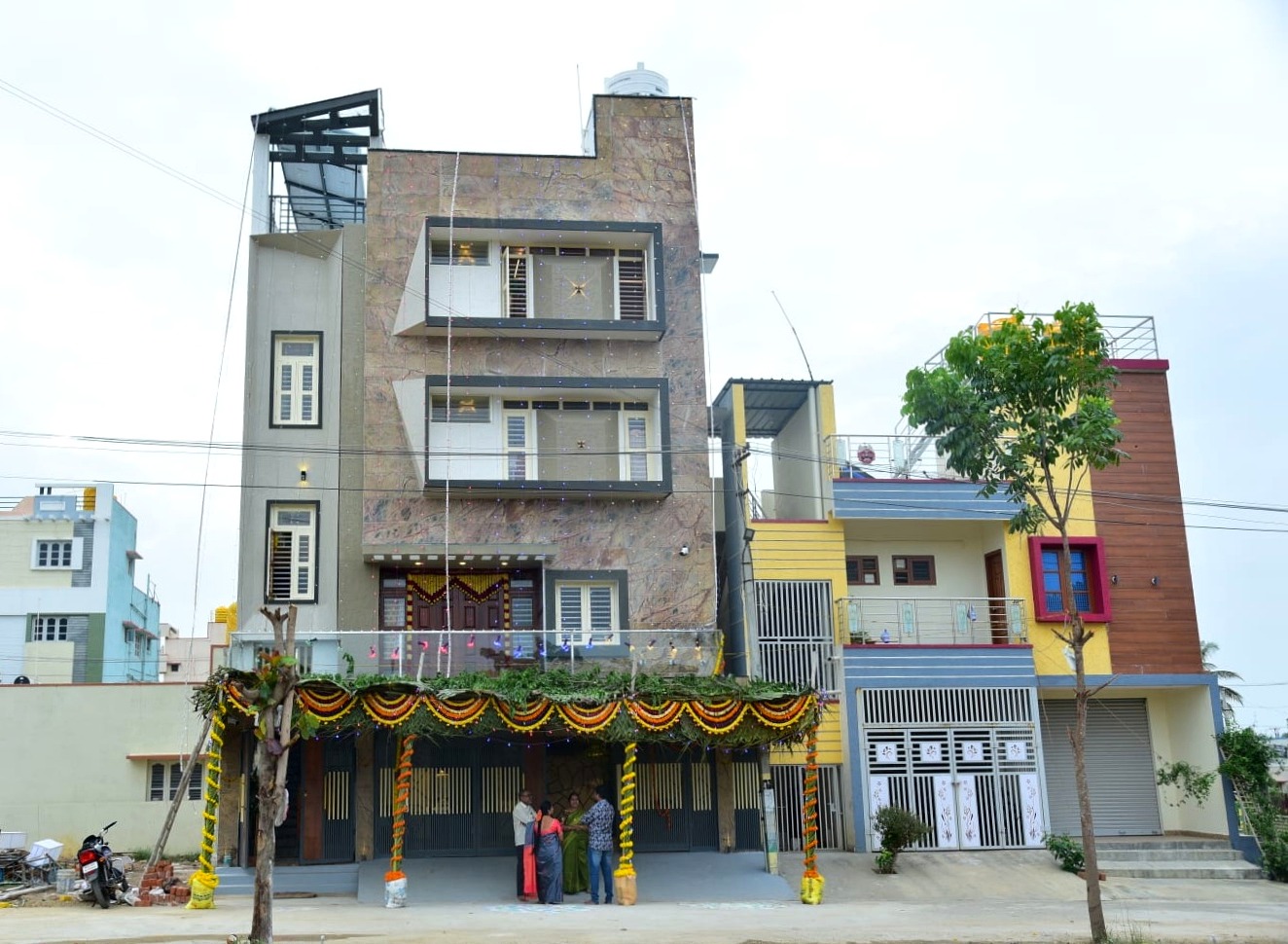
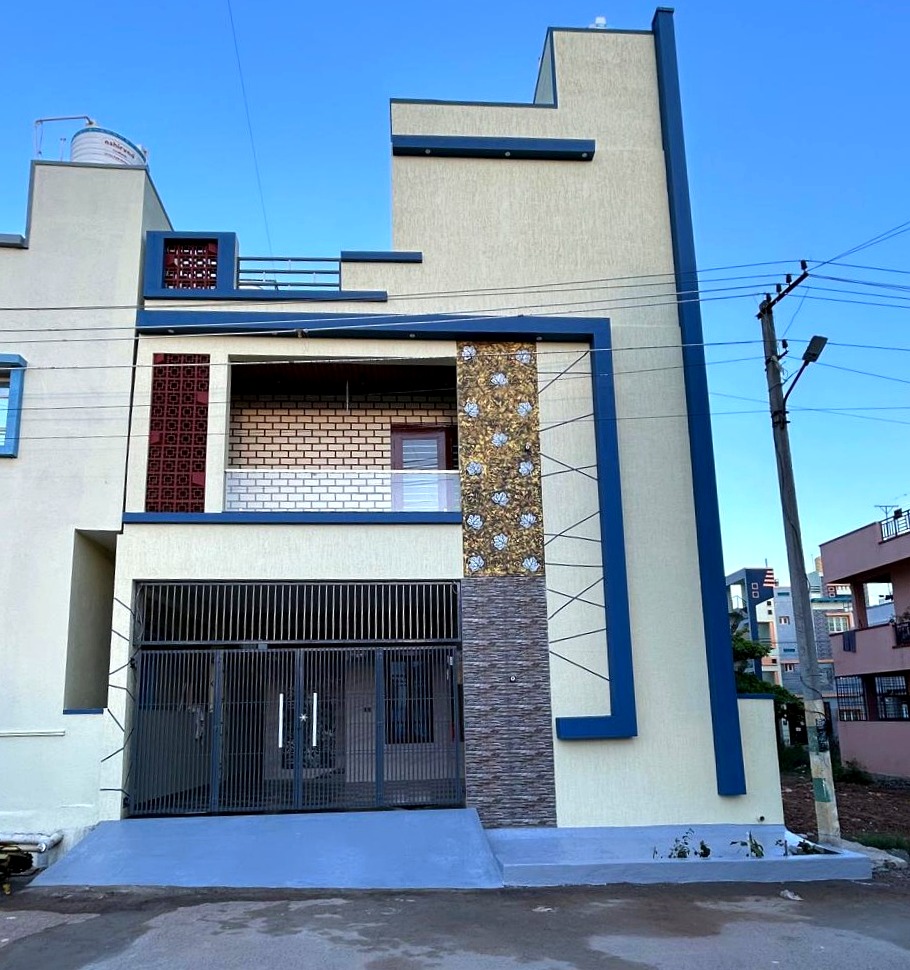
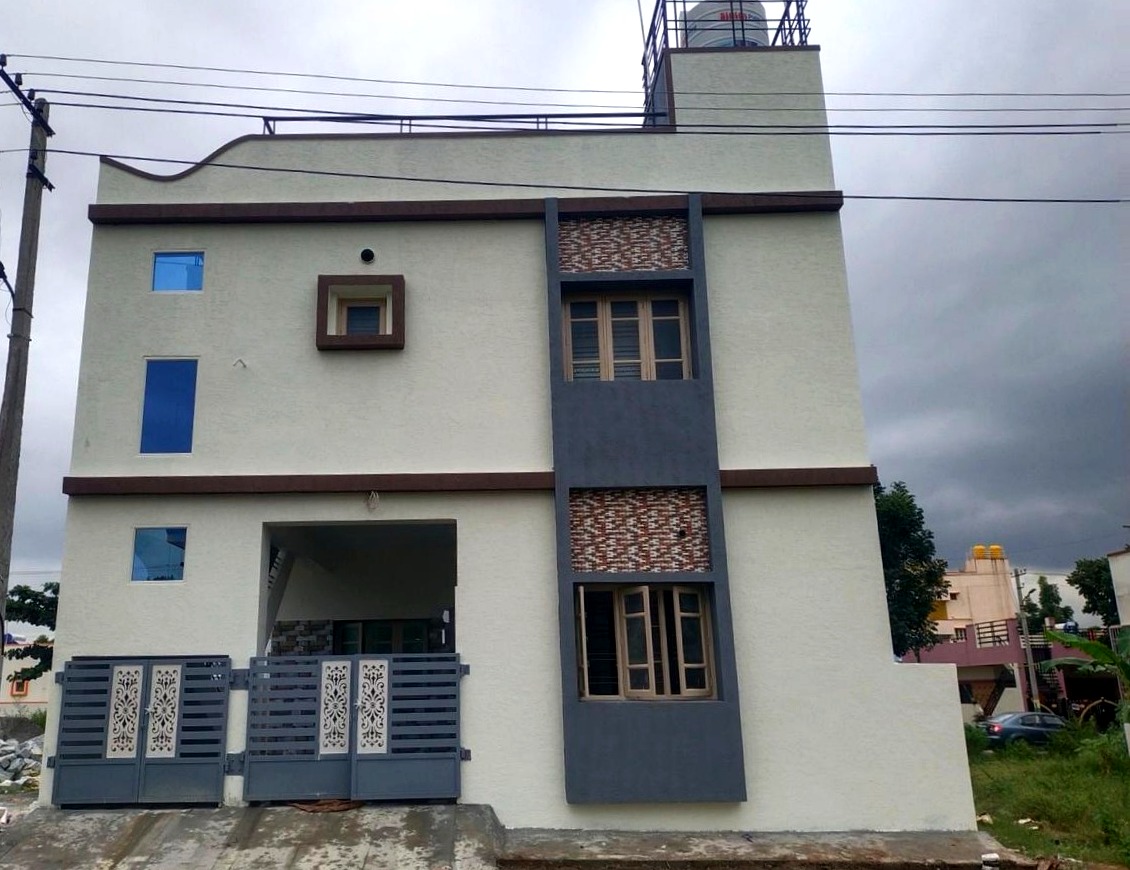
Every project documented from plot to handover. Click any project to see the full case study with timeline, challenges, and outcomes.
✓ COMPLETED
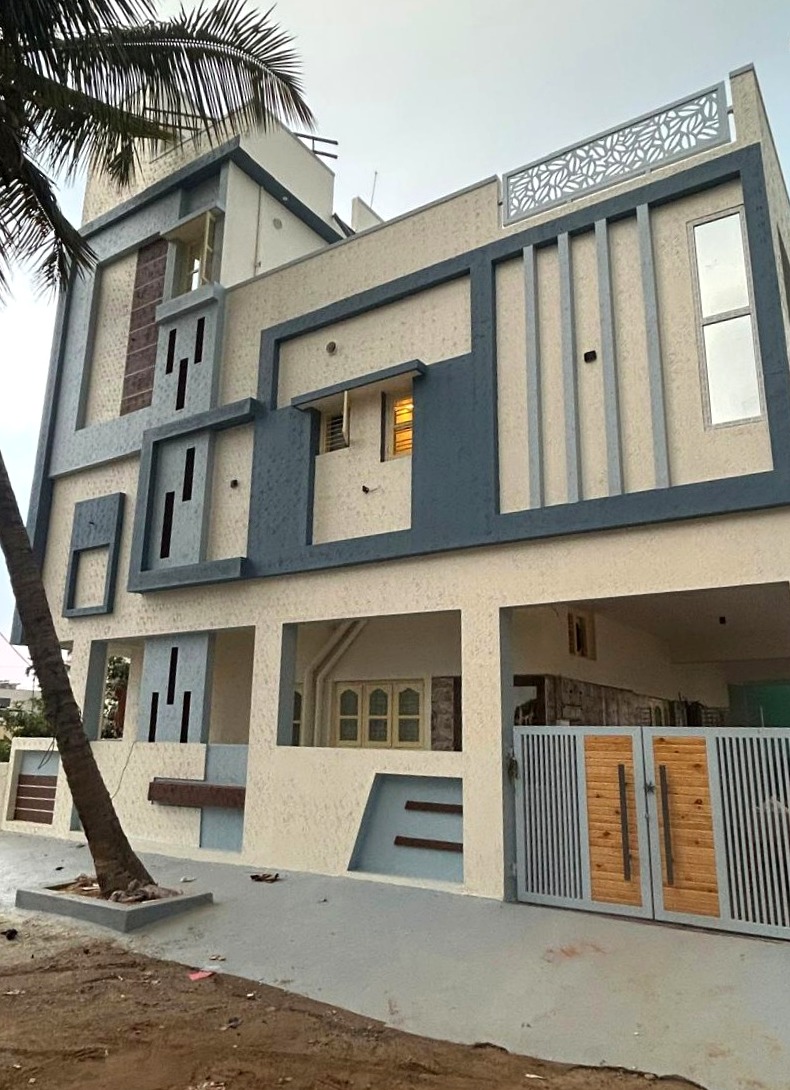
The Manjunath family wanted a striking, low-maintenance elevation on a 30x40 site, without compromising on natural light inside.
✓ COMPLETED
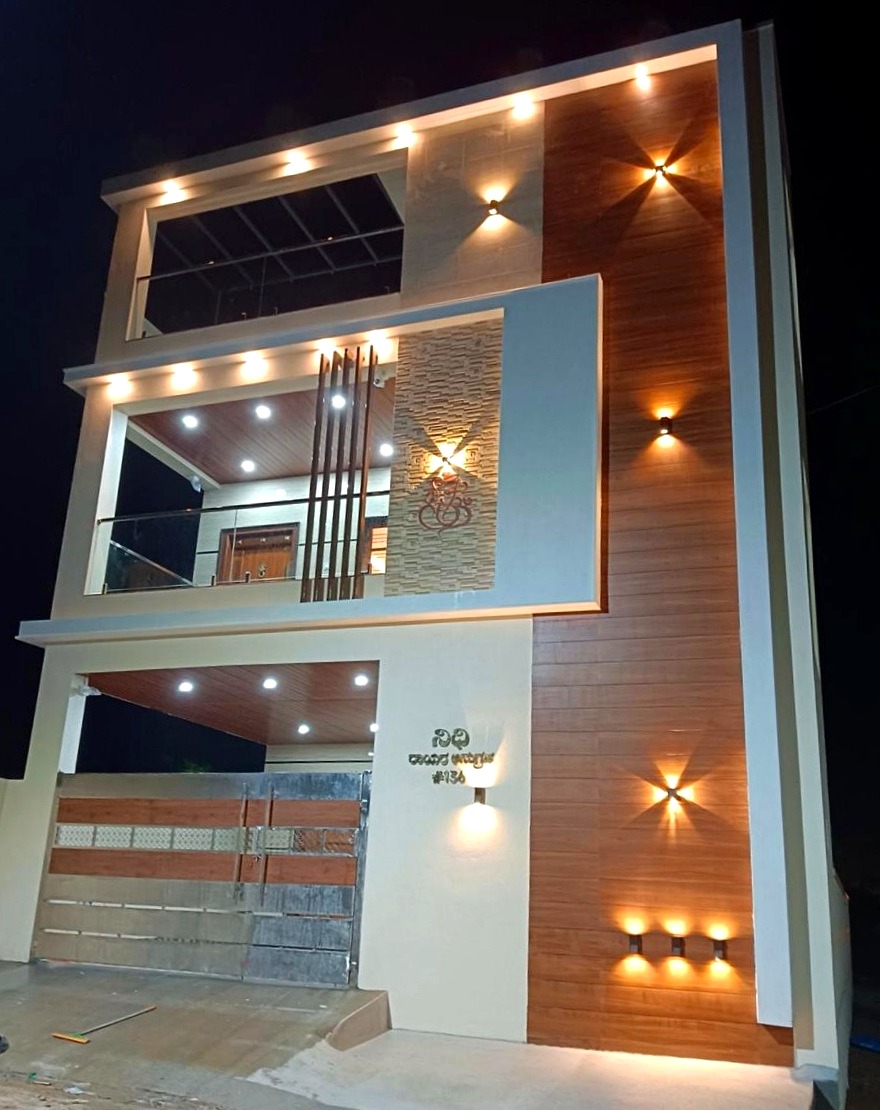
The Prakash family wanted their home to stand out after dark as much as in daylight, with a warm wood-and-stone exterior on a spacious 30x50 site.
✓ COMPLETED
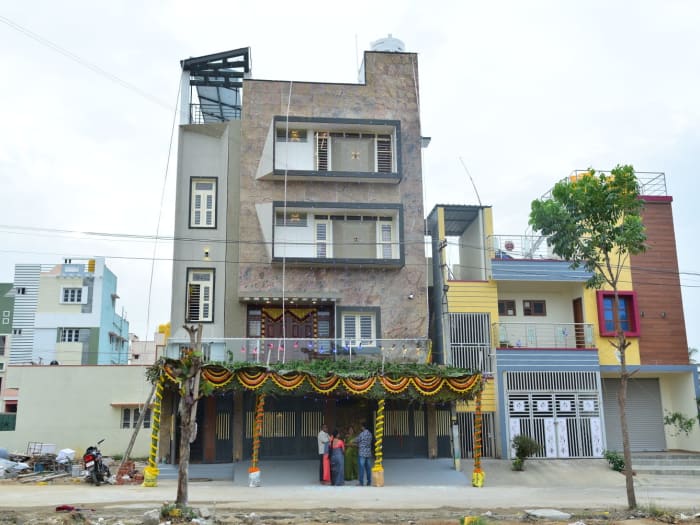
The Srinivas family had a 30x40 frontage plot and needed a design that still felt spacious and modern.
✓ COMPLETED
The Nagaraj family wanted ground-floor shop space for rental income on their 30x50 site, with two full residential floors above.
✓ COMPLETED
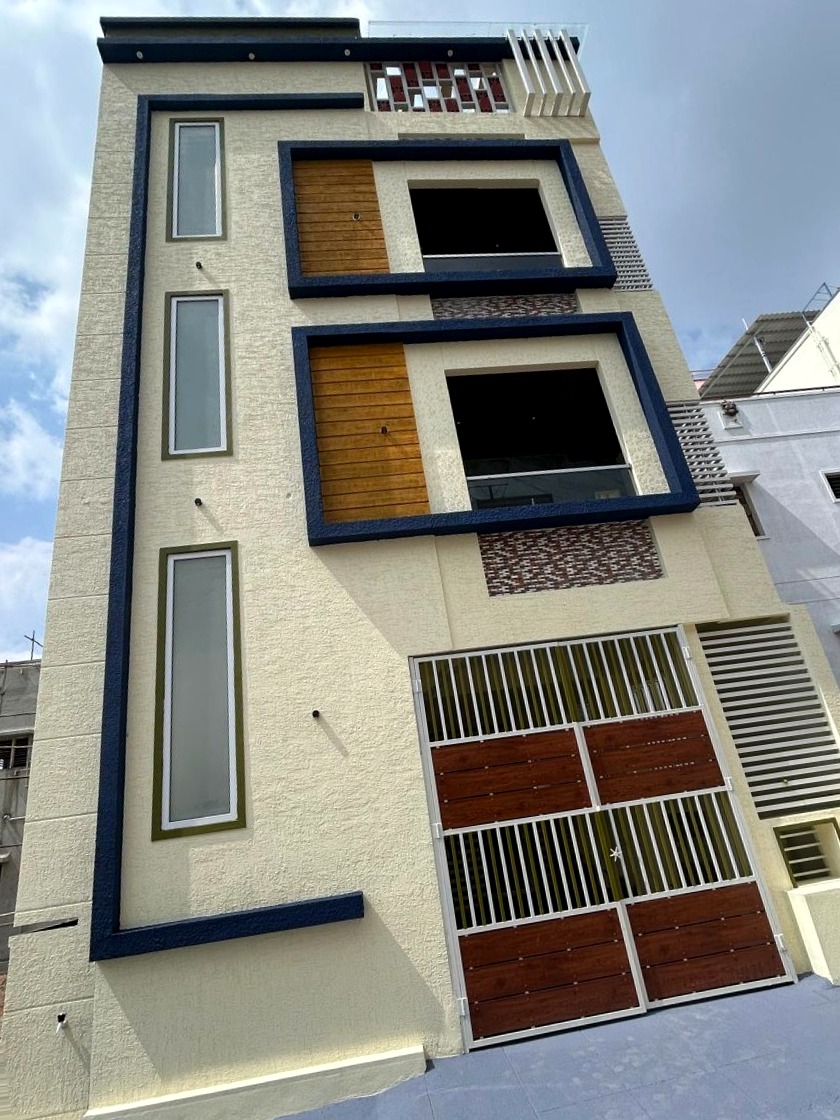
The Ravindra family wanted a clean, modern look on a budget, on a 30x40 plot, with a feature stone wall as the standout element.
✓ COMPLETED
The Chandrashekar family prioritized a large open car porch on their 30x50 site, building for current needs first.
We have photos from foundation to finish for every project. Ask us.
Every item listed below is included in the quoted rate, or clearly marked as optional. No surprise costs at the end.
Rates cover construction cost only. Compound wall, gate, borewell, Panchayat approval fees, and BESCOM connection are separate.
₹20,000 – ₹80,000 depending on plot size and BUA. We help with documentation.
Borewell: ₹60,000–₹1,20,000. Sump construction: ₹35,000–₹70,000.
Compound wall: ₹400–₹650/running foot. Main gate: ₹25,000–₹80,000.
₹15,000–₹45,000 depending on load sanctioned and pole distance.
₹1,20,000–₹3,50,000 depending on size, material, and brand.
Optional. Paver driveway: ₹80–₹120/sqft. Garden landscaping: varies widely.
Every material choice affects your home's durability, finish, and maintenance cost. Here's exactly what we specify — and what to watch out for if you're comparing contractors.
We never use unbranded cement. Verify by checking cement bags on site — they should show BIS mark and grade clearly.
Fe500D means ductile steel — critical for earthquake resistance. Hoskote is in Seismic Zone II. Insist on D-grade, not just Fe500.
AAC blocks offer better thermal insulation — homes stay cooler in Hoskote's summer. We recommend AAC for external walls.
We use M-Sand (manufactured sand), not river sand — it's consistent in grade, free of silt, and doesn't contribute to riverbed depletion. Used for plastering, masonry, and concrete work.
Chlorinated PVC resists hard water scaling common in Hoskote's groundwater. Better than regular PVC for hot water lines.
Flame-retardant wiring is mandatory in residential construction. Never accept sub-standard wiring hidden in walls — you can't replace it easily.
Hoskote receives heavy monsoon rain. Two-coat crystalline waterproofing on the terrace slab is non-negotiable. Don't accept single-coat application.
Glazed vitrified tiles are more scratch-resistant than regular ceramic. For bedrooms and living areas in Hoskote's dusty environment, they're the better long-term choice.
Exterior paint in Hoskote must handle 1,000mm+ annual rainfall and 38°C summers. Elastomeric weather coat lasts 7–10 years vs 3 years for standard emulsion.
Building without an approved plan is illegal in Hoskote and can result in demolition orders. Here's exactly what you need.
Hoskote falls under the jurisdiction of various Grama Panchayats. Under Karnataka Panchayat Raj Act and KTCP Act, any construction above 40 sqm (430 sqft) requires a Building Plan Sanction from the Panchayat before commencing construction.
Unapproved construction can be demolished by Panchayat authorities. It also creates complications in obtaining BESCOM connection, home loans, and later property registration.
| Plot Size | Construction Area | Approx. Fee |
|---|---|---|
| 30×40 (1,200 sqft) | Up to 1,200 sqft | ₹20,000–₹35,000 |
| 30×50 (1,500 sqft) | Up to 1,800 sqft | ₹30,000–₹50,000 |
| 40×60 (2,400 sqft) | Up to 2,800 sqft | ₹45,000–₹70,000 |
| 50×80 (4,000 sqft) | Up to 5,000 sqft | ₹65,000–₹1,00,000 |
Read this before you speak to any contractor. Knowledge is your best protection.
Construction loans work differently from apartment purchase loans. Here's what to expect.
We work regularly with SBI and HDFC for construction loans in Hoskote. We can connect you with the right branch officer and help prepare your file.
Help Me Get a Construction Loan| Cost Component | Typical Range | Notes |
|---|---|---|
| Plot Registration & Stamp Duty | 5–7% of plot value | One-time at purchase |
| Panchayat Plan Approval | ₹20K–₹80K | Before construction |
| Soil Test & Structural Design | ₹15K–₹35K | One-time |
| Main Construction Cost | ₹1,800–₹2,200/sqft | Our packages |
| Borewell Drilling | ₹60K–₹1.2L | If needed |
| Underground Sump | ₹35K–₹70K | Recommended |
| Compound Wall | ₹400–₹650/rft | Perimeter |
| Main Gate | ₹25K–₹80K | Wrought iron/MS |
| BESCOM Connection | ₹15K–₹45K | Depends on load |
| Interior Design / Furniture | ₹3L–₹15L | Optional |
| Landscaping | ₹50K–₹3L | Optional |
| Contingency Buffer | 10–15% | Always keep this |
Most Hoskote families use a mix: 30–40% own funds, rest through a construction loan. Banks disburse in stages matching your construction progress — which aligns perfectly with our stage-wise payment system.
Send us a WhatsApp to receive any of these resources instantly. No email signup, no cost.
Compiled from real questions we've received from families across Hoskote, Sulibele, Anugondanahalli, Channasandra, and Kannamangala.
As of 2026, house construction in Hoskote costs ₹1,800–₹2,200 per square foot for a well-built RCC-framed house. ₹1,800/sqft gives you a solid, quality home (Comfortable package). ₹2,000/sqft gives you better finishes, premium tiles, and UPVC windows (Better-Living). ₹2,200/sqft gives you a premium home with modular kitchen, marble flooring, and designer elements (Dream Home). These rates include structure, walls, plumbing, electrical, flooring, doors, windows, and painting. They exclude land, Panchayat fees, borewell, compound wall, and BESCOM connection.
A 30×40 plot (1,200 sqft) with a ground-floor house of approximately 900–1,000 sqft built-up area will cost ₹16–22 lakhs depending on package. If you build G+1, the total construction area would be 1,600–1,800 sqft across both floors, costing ₹29–40 lakhs. Use our cost calculator above for your exact configuration.
Our per-sqft rate does not include: Panchayat plan approval fees (₹20,000–₹80,000), borewell drilling (₹60,000–₹1,20,000), underground water sump construction, compound wall and gate, BESCOM electrical connection charges, soil testing, modular kitchen (except in Dream Home package), landscaping, and interior furniture. We quote all of these separately so there are no surprises.
Construction quotes that seem very low (below ₹1,500/sqft) usually cut corners on material brands — using unbranded cement, lower-grade steel, thin plaster, or cheap tiles. The cheapest quote is rarely the best value when it's your home. We specify exact material brands in writing before signing. If another contractor quotes lower, ask them to match our material specification sheet exactly — then compare. Also ask whether their rate includes what ours does.
You can, but it requires time, transport, and vendor management. We can offer a material-only or civil-work-only arrangement where we handle labour and supervision while you source some materials. However, for most families with jobs in Bangalore, this adds considerable stress. If you prefer to supply certain items (tiles, fittings, paint), we can accommodate that and adjust the quote accordingly.
For construction contracts above ₹7.5 lakhs where land and building are together, GST applies at 5% without ITC. For pure construction services (where you own the land), GST is 18% on the service portion. We explain the applicable GST structure during quotation and provide full GST invoices for every payment. We do not do cash-only work — every rupee is documented.
A typical ground-floor (G) house takes 6–8 months from agreement signing to handover. G+1 takes 9–12 months. G+2 takes 14–18 months. These timelines assume normal monsoon weather and materials availability. Delays can occur during June–September due to heavy rains slowing concrete curing and plastering. We build realistic timelines into every agreement and give written timeline milestones.
Structural work like foundation and RCC can proceed during light rain with proper curing management. Plastering, painting, and tile work must pause during heavy rain as moisture affects finishing quality. We plan construction schedules to front-load structural work before monsoon (June) and target finishing work for October–March. We never rush finishing work in wet conditions — it causes long-term problems like peeling paint and hollow tiles.
Our agreement includes a timeline with milestone dates. If delays are caused by us (not by weather, approvals, or client changes), we pay a penalty as defined in the agreement. We proactively inform you on WhatsApp when any delay is anticipated and why, rather than waiting for you to discover it. In our experience, honest communication about delays is far better than covering them up.
Payments are tied to construction milestones. Typical breakdown: 10% mobilisation advance at agreement signing → 15% after foundation complete → 20% after ground floor slab → 15% after first floor slab (if applicable) → 15% after walls and MEP rough-in → 15% after tiling and plaster → 10% at handover. You receive photos and optionally visit the site before each payment is requested. You approve, then transfer. No payment is ever requested before the milestone is complete and you've seen it.
No. Many of our clients work in Bangalore or even in other cities. We send daily WhatsApp photos and videos so you see every development. Major decisions (tile choices, door designs, paint colours) are handled via video call or WhatsApp. You visit for the initial site meeting, possibly once or twice during key stages if you wish, and for the final walk-through. Everything else is managed remotely without compromising quality.
Minor changes (moving a switch position, adjusting room partition dimensions) are usually possible and sometimes free. Structural changes after foundation or slab is cast are expensive and sometimes impossible. Major design changes midway (adding a room, changing the floor plan) will require a variation order with revised cost and timeline. This is why we spend time getting the floor plan right before starting — changes after starting are always costlier than getting it right upfront.
This is the most important question you can ask any contractor, and we respect it. Three protections: (1) You never pay more than one milestone at a time — maximum exposure at any point is one stage's payment. (2) We have a physical office in Hoskote, UDYAM registration, GST registration — we're not anonymous. (3) Our business depends on Hoskote word-of-mouth — disappearing would destroy us permanently. We also provide a written agreement with your right to terminate and recover balance materials in case of default by us.
We take a mobilisation advance of 8–12% of the contract value. This covers initial material procurement and the first two weeks of labour. After this, every subsequent payment is milestone-based — you pay only after you see the completed stage and approve it. We never ask for large upfront payments. Any contractor asking for 30–50% advance before starting should be a red flag.
Yes — always, before any work starts. The agreement covers: total construction cost and payment schedule, construction scope (what's included and excluded), floor plan and elevation (attached as annexure), material specifications (exact brands and grades), construction timeline with milestone dates, warranty terms (1 year structural), dispute resolution process, and termination clauses for both parties. We send you the draft and encourage you to review it with a lawyer if you wish before signing.
We provide a 1-year comprehensive warranty from the date of handover. This covers: structural defects, terrace waterproofing failures, plumbing leaks, electrical faults, and tile delamination (hollow tiles). Warranty claims are addressed within 7 working days of notification. The warranty letter is given in writing at handover. Normal wear and tear, damage from third-party work, and cosmetic issues from misuse are not covered.
Absolutely. We encourage this. We can arrange for you to visit completed homes in Hoskote and speak directly to the families who live there. We also share photo documentation of projects from Day 1 through handover on WhatsApp. We have no reason to hide our work — it's standing in Hoskote right now. WhatsApp us and ask.
Our agreement includes a dispute resolution clause. First step is a direct meeting with the team lead. If unresolved, we go to a neutral third-party engineer for technical disputes. Financial disputes are resolved via formal mediation. In three years of work in Hoskote, we have not had a formal dispute reach escalation — because our stage-payment system means problems are caught and fixed stage by stage, not discovered at the end.
We strongly recommend a soil bearing capacity test (SBC test) for plots where the soil type is unknown or visually soft, sandy, or near water bodies. Cost is ₹5,000–₹15,000 and takes 3–5 days. It determines whether you need a standard footing or a deeper/wider foundation. Skipping this and guessing wrong can mean under-designed foundations — a very costly problem to fix later. For plots with known good laterite or red soil, the risk is lower.
We use M20 concrete (1:1.5:3 ratio, 20 N/mm² compressive strength) as minimum for all structural elements: columns, beams, slabs, and foundations. For higher loads or G+3 buildings, we use M25. PCC (Plain Cement Concrete) for the bed layer uses M15. We use Ultratech or ACC OPC 53 Grade cement throughout. The exact mix design is specified in the structural drawings prepared by our engineer.
We primarily use AAC (Autoclaved Aerated Concrete) blocks for external walls. They're lighter than red bricks (reducing structural load), have better thermal insulation (keeping homes cooler in Hoskote's 35–38°C summers), and have good soundproofing. For load-bearing walls where higher strength is needed, we use fly ash bricks (IS 12894 compliant). We avoid ungraded or locally kiln-burnt red bricks as they have inconsistent quality.
Standard RCC slabs in our construction are 115–125mm (4.5–5 inches) thick for residential floors — as per IS 456 and our structural engineer's design. Terrace slabs may be slightly thicker to accommodate waterproofing layer. We never go below 100mm regardless of cost pressure — thin slabs crack, deflect, and create long-term problems. The slab thickness and steel reinforcement design is documented in structural drawings provided to you.
We use a two-stage waterproofing system on all terraces: a crystalline waterproofing compound applied to the slab surface (Dr. Fixit or Fosroc) followed by a polymer-modified mortar screed with slopes directing water to drain points. Hoskote receives significant rainfall, and terrace waterproofing failure is the single biggest post-construction complaint we hear about other contractors. We do not cut corners here.
We work with empanelled civil engineers and licensed building designers. For Panchayat plan approval, structural drawings signed by a licensed engineer are mandatory. We arrange this as part of our service. If you already have an architect you want to work with, we can work under their design supervision. Architectural design fees (if applicable) are quoted separately — they typically range from ₹15 to ₹35 per sqft depending on complexity.
Every TMT bar from reputed manufacturers (JSW, Jindal, SAIL) has the brand and grade rolled into the bar itself — you can see it physically. The delivery invoice also mentions grade and steel mill. Ask your contractor to let you see a bar and the delivery challan when steel arrives. Bars should be free of excessive rust, uniform in diameter, and have the characteristic ribbed surface of TMT bars. We encourage our clients to be present for steel deliveries.
AAC blocks are factory-made from cement, fly ash, lime, and aluminium powder — resulting in a lightweight, thermally insulating block. They're 3x larger than red bricks but 4x lighter, reducing dead load on the structure. Red bricks are traditional kiln-fired clay blocks — heavy, good compressive strength, but variable quality and poor insulation. In Hoskote's climate, AAC block walls keep interiors significantly cooler, reducing cooling costs. They also have better fire resistance. The main downside: cost is 15–20% higher than red bricks, but the structural savings often offset this.
Technically some people do — but it's illegal and risky. Unapproved structures can receive demolition notices from the Panchayat. You'll also face problems getting BESCOM connection, home loan, and eventually property registration. Banks increasingly verify plan approval before disbursing construction loans. We never start construction without confirming approval is in place — it protects both you and us.
Typically 15–45 days from submission of a complete application. Delays happen if documents are incomplete, if the plot has any Khata or survey number issues, or if the Panchayat has a backlog. By starting the approval process the moment you confirm you want to build, we can get approval done before your loan disbursal is ready — so construction isn't delayed waiting for paper work.
Agricultural land must be converted to residential use (NA / Non-Agricultural) before building a house. This is a DC Conversion (Deputy Commissioner Conversion) process in Karnataka. Cost varies by plot size and location. Timeline is typically 3–6 months. This is separate from Panchayat plan approval. Without DC Conversion, Panchayat will not grant building permission, and banks will not give construction loans. We can refer you to a property lawyer who handles DC conversions in Hoskote Taluk.
An Occupancy Certificate (OC) or Completion Certificate from the Panchayat formally states that the building was constructed as per approved plans and is safe for occupation. It's not always enforced for individual houses in rural Panchayats, but it's important for future property sale, registration changes, and some bank loans. We prepare and submit the completion certificate application on your behalf after handover.
FAR (Floor Area Ratio) or FSI (Floor Space Index) limits the total built-up area allowed as a multiple of your plot area. Under Hoskote Panchayat norms, FAR is typically 1.5–2.0 for residential. On a 1,200 sqft plot, with FAR 1.5, you can build up to 1,800 sqft total. Setbacks (minimum gaps from plot boundaries) also apply. Our building designer calculates the maximum permissible area before finalising your floor plan.
Yes. SBI, HDFC, Canara Bank, and Karnataka Bank all offer construction loans for plots in Hoskote. Requirements: clear title deed, Panchayat plan approval, construction agreement with a licensed contractor (that's us), estimated construction cost from a civil engineer, and income proof. Loan-to-value ratio is typically 75–80% of construction cost. Disbursement happens in stages — matching our stage-wise payment structure perfectly.
For flat purchase, the bank gives you one lump-sum amount against the developer's RERA-registered project. For construction loans, the bank releases money in tranches (stages) as construction progresses — verified by bank-appointed valuers who physically inspect the site before each disbursement. This means you don't pay EMI on the full amount from Day 1 — you pay on only the disbursed amount. Interest during construction (pre-EMI interest) is manageable if the construction moves quickly.
Banks generally lend 75–80% of the total project cost (land + construction), subject to your income eligibility. If your total project cost is ₹60 lakhs and you can support a ₹45 lakh loan on your income (EMI should not exceed 40–45% of net monthly income), the bank will consider it. For a ₹45L loan at 8.75% over 20 years, the EMI is approximately ₹40,000/month. Use our EMI calculator on this page to model your scenario.
Most banks prefer CIBIL 750+. Below 700 makes it difficult but not impossible. Options: apply with a co-applicant with a higher score, use KSFC (Karnataka State Finance Corporation) which has different criteria, approach smaller cooperative banks like Karnataka Bank or district cooperative banks, or improve your score first (6–12 months of on-time payments and reducing credit utilisation). We can refer you to a loan consultant who specialises in Hoskote area construction loans.
Yes. We serve Hoskote Town, Sulibele, Anugondanahalli, Kannamangala, Channasandra, Devanahalli Road, Vijayapura, Jadigenahalli, Nandagudi, Budigere Road, Old Madras Road properties, and KR Puram outskirts up to about 15km from Hoskote. If your plot is outside these areas, WhatsApp us — we'll tell you honestly if we can serve you.
Most of Hoskote has red laterite soil or hard gravel soil — excellent for construction with good bearing capacity. Areas near the lake (Hoskote Lake and Bettakote Lake region) have softer alluvial deposits requiring deeper foundations. Agricultural areas with deep black cotton soil need special foundation design (well-foundation or raft). We assess soil conditions during the free site visit and recommend accordingly. A formal SBC test costs ₹5,000–₹15,000 for official documentation.
Hoskote area has multiple Grama Panchayats depending on the village survey number. Hoskote Town Panchayat, Anugondanahalli Grama Panchayat, Nandagudi Grama Panchayat, Sulibele Grama Panchayat, and Jadigenahalli Panchayat are the main ones. To confirm which Panchayat covers your specific plot, check your Khata certificate — it will mention the Panchayat name. We know the local procedure for each Panchayat office in the area.
Hoskote town has several hardware and building material shops on the main road near the bus stand and around the KIADB industrial area. For tiles, there are showrooms in Hoskote town. For better selection (especially premium tiles, modular kitchens, premium fittings), Whitefield and Electronic City in Bangalore are nearby. We have supplier relationships and can take you to our preferred vendors — you benefit from our volume pricing.
Construction material costs (cement, steel) have been rising 6–10% per year. Labour costs rise similarly. Waiting 2 years means your same house could cost 12–18% more to build. If you have land and a clear plan, building sooner rather than later typically makes financial sense. The decision depends on your personal readiness, not market timing. What we do recommend: don't rush the contractor selection — take your time there.
Every floor plan is customised to your plot dimensions, BHK requirement, family structure, and preferences. We discuss: number of bedrooms and bathrooms, puja room, parking, overhead tank position, kitchen ventilation, natural light direction (vastu if relevant to you), and future expansion plans. After the site visit, we prepare a preliminary plan and revise until you're happy — before signing anything.
Yes. Many of our clients in Hoskote prefer vastu-compliant designs. We work with vastu principles as a design input while ensuring structural soundness and practical usability. Common requests: main door facing east or north, kitchen in south-east, master bedroom in south-west, puja room in north-east. We'll design within vastu guidelines as long as they're compatible with your plot orientation and structural requirements.
For Hoskote's climate, UPVC is better long-term. UPVC doesn't rust, corrode, or require painting, has better thermal insulation, and seals better against dust from the highway. Initial cost is 30–40% higher than aluminium. Aluminium is cheaper, lighter, and more widely available for repair/replacement locally. For the Better-Living and Dream Home packages, we specify UPVC. For Comfortable, we use aluminium — it's still a quality choice, just different.
For bathroom floors, we use anti-skid ceramic tiles (R10 or R11 rating) from Kajaria, Johnson, or Somany. For bathroom walls, full-height glazed ceramic tiles are best — they're moisture-proof, easy to clean, and reduce wall dampness over time. In the Comfortable package, we tile to 7ft height; in Better-Living and above, we tile full height. We recommend grout from Laticrete or Mapei — they're mould-resistant unlike cheap grout.
If your budget allows, building the structural framework for G+1 now (even if you only finish the ground floor) is far cheaper than adding later. Key: design the structural columns and beam spacing for eventual G+1 load from Day 1. Adding another floor to a structure not designed for it requires structural assessment and often costly retrofitting. We offer an option to design for future expansion at marginal additional structural cost now.
Yes — this is a common approach in Hoskote for families with limited budget initially. Build one wing or one floor structurally complete, move in, and add the remaining portions later. The key is designing the entire structure upfront so Phase 2 integrates seamlessly. We offer phased construction planning at no extra design charge when you engage us for both phases together.
New houses go through a curing and settling period. Normal hairline cracks may appear at plaster joins in the first monsoon — these are mostly cosmetic and expected in RCC structures. Check terrace drainage after the first heavy rain. Test all electrical points and plumbing annually. If any crack appears in structural elements (columns, beams), contact us immediately under warranty. Most cosmetic issues can be addressed in the first touch-up round, typically 6 months after handover.
Exterior paint: every 5–7 years if weather coat was used, every 3–4 years for standard emulsion. Hoskote's combination of monsoon rain and summer sun accelerates exterior paint degradation compared to drier climates. Interior paint can last 7–10 years before repainting looks necessary. Before repainting, ensure there are no seepage or moisture issues causing paint to peel — fixing the source is more important than repainting on top of a damp surface.
Yes. Many families come back for additional rooms, second-floor construction, renovation, painting, or repairs. We maintain relationships with our clients because referrals are our primary business growth in Hoskote. Give us a WhatsApp — we'll visit, assess, and quote fairly.
Keep these permanently: Original plot sale deed and registration document, Khata certificate and tax receipts, Panchayat building plan approval letter, Construction agreement (our signed copy), Completion/Occupancy certificate, Electrical test certificate, BESCOM meter connection papers, Borewell details and depth, All GST invoices from construction, Structural drawings (for future addition/renovation reference), and Warranty letter from contractor. We provide all construction-related documents in a WhatsApp folder at handover.
Hairline cracks (less than 0.3mm wide) in plaster at corners, above door frames, or at construction joints are normal in any concrete building and are cosmetic. These appear when the structure settles. Wide cracks (more than 1mm), diagonal cracks near column bases, cracks through columns or beams, or any crack that grows over time are structural warning signs — contact a structural engineer immediately. During our 1-year warranty, report any crack to us and we'll assess it.
We focus on construction and don't provide interior design services ourselves. However, we can refer you to trusted interior designers and modular kitchen vendors in the Hoskote–Whitefield area who we've worked with. For the Dream Home package, the modular kitchen is included in our scope. For other packages, we can do basic civil works related to kitchen (counter, dado) and you source the modular kitchen separately.
We typically respond within 2 hours on WhatsApp. Ask anything — no question is too basic.
📱 Ask on WhatsAppWe'll connect you with any of these families if you want to verify. No anonymous reviews.
Want to speak to any of these families before making your decision?
📱 Request Customer ReferencesOur team knows the local roads, Panchayats, soil conditions, and suppliers across every area of Hoskote Taluk.
We are a construction company rooted in Hoskote, Bengaluru Rural. We're not a large faceless contractor — we are the people you'll actually call when you have a question at 8pm about your construction.
Our construction partner, Sai Construction, has been active in Hoskote for years. We bring together local execution expertise with transparent, documented processes — because we believe the biggest problem in construction is not skill, it's trust.
📍 Balaji Gold City, Hoskote 562114 · Mon–Sat 9AM–6PM
Fill in the form below or WhatsApp us directly. We respond within 2 hours on working days.
We'll reach out within 2 hours. Check WhatsApp for a confirmation message.
Or WhatsApp directly: +91 78926 69947
Balaji Gold City
Hoskote, Bengaluru Rural
Karnataka — 562114
Mon–Sat: 9:00 AM – 6:00 PM
Sunday: 10:00 AM – 2:00 PM (by appointment)